Why Do You Need Debt Funds When You Already Have PPF and EPF?

Quick answer: PPF and EPF suit long-term saving, but they lock your money. Debt funds fill the gaps. They have no fixed lock-in, accept any amount, and suit goals 1 to 5 years away. Their returns are not guaranteed. Their gains are taxed at your slab rate, which is the tax rate on your income.


What Is the Right Asset Allocation for Your Age and Goals?

Short answer: There is no single right mix. Start with your goal’s time horizon. Keep goals under 2–3 years in debt. Use more equity for long goals. The 100-minus-age rule is a simple start: at age 30, it gives about 70% equity. Then adjust for your risk comfort and review once a year. Key Facts

Can You Go Passive With Your Debt Fund Investments Too?

Short answer: Yes, but only partly. Target maturity and gilt index funds let you follow a bond index at low cost. They suit goals with a fixed end date. India has few passive options for corporate bond or short-term needs. So many investors mix passive and active debt funds. Key Facts Passive debt funds follow

Smart Money Rules: 8 Rules to Check Before You Buy

Short answer: Use a simple rule before every big money decision. For a car, pay 20% down, repay within 4 years, and keep all car costs near 10% of income. Keep total loan EMIs near 35–40% of take-home pay. Pay credit cards in full. Spread your investments. Start retirement saving early. Key Facts The 20/4/10

2026 Money Checklist for Indian Families: 7 Things to Check First

Last updated: 17 October 2026 Quick answer: Before you save or invest, run seven checks. Compare Sukanya Samriddhi Yojana (8.2%) for a girl child. For a boy, ask about Ponmagan Podhuvaippu Nidhi or PPF (7.1%). Understand NPS tax rules. Read FD penalty terms. Compare insurance claims, not just premium. Check credit card charges. Verify SEBI

Person checking a credit card bill and monthly budget to use a credit card wisely in India

How to Use a Credit Card Wisely in India: 5 Simple Rules

Quick answer: Use a credit card wisely by spending only what you can repay. Pay the full bill before the due date every month. Then you earn cashback and reward points without paying interest. If you pay only the minimum amount due, interest starts, and you may lose the interest-free period. Check reward value, redemption

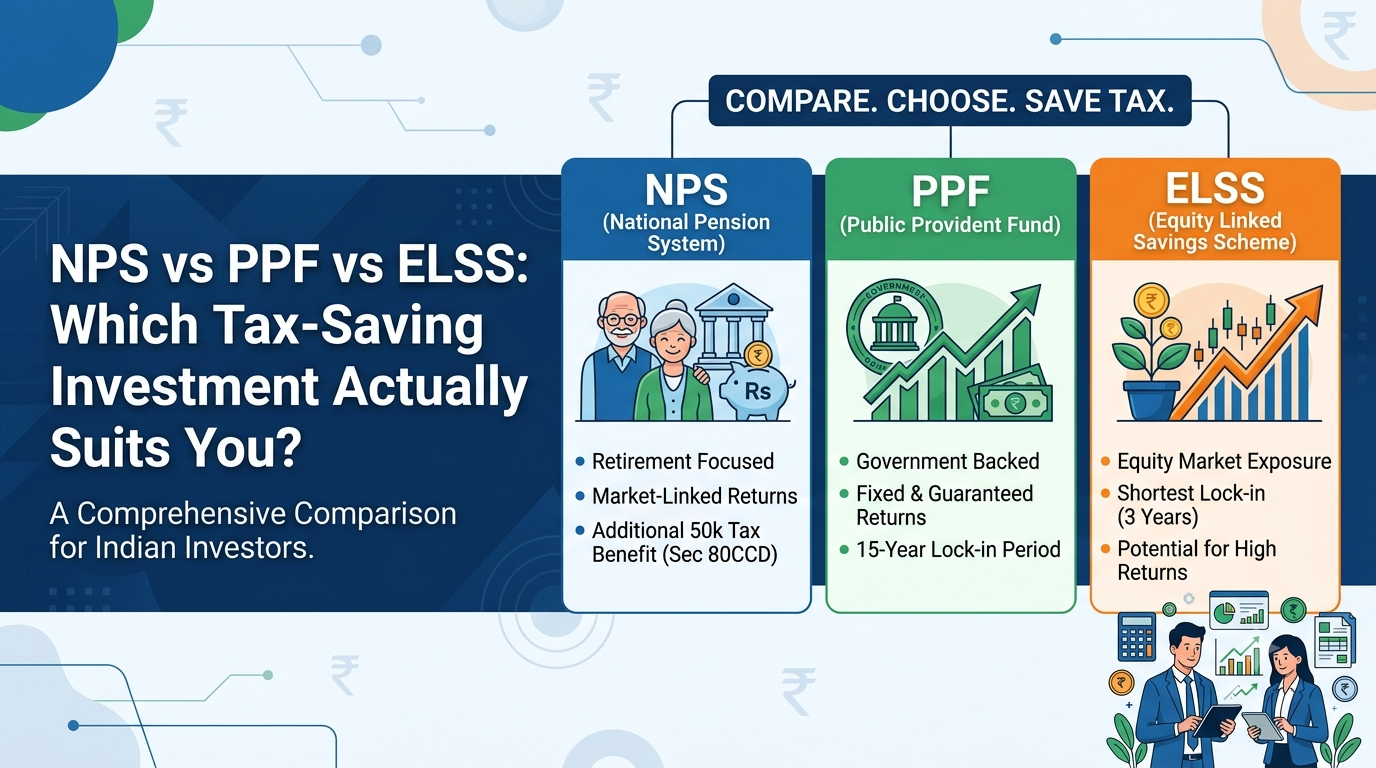
NPS vs PPF vs ELSS: Which Tax-Saving Investment Actually Suits You?

Choose PPF for safe, fixed and tax-free returns. Choose ELSS for growth if you can stay invested for five years or more. Choose NPS for a retirement fund and an extra ₹50,000 deduction. You can claim a deduction for all three only under the old tax regime. Many families use a mix of the three.

How Much Equity Should You Hold After Retirement?

Quick answer: Most Indian retirees hold 30% to 50% of their money in equity (shares and equity mutual funds). A popular simple rule is 100 minus your age. Your share depends on your expenses, other income, and comfort with market falls. Keep 5 to 7 years of expenses in safer assets. Key Facts Inflation (the

Disclaimer

Investments in Mutual Funds are subject to Market Risks. Read all scheme related documents carefully before investing. Mutual Fund Schemes do not assure or guarantee any returns. Past performances of any Mutual Fund Scheme may or may not be sustained in future. There is no guarantee that the investment objective of any suggested scheme shall be achieved. All existing and prospective investors are advised to check and evaluate the Exit loads and other cost structure (TER) applicable at the time of making the investment before finalizing on any investment decision for Mutual Funds schemes. Before making an investment, please contact the investment expert at Deepak Wealth Framework for designing a portfolio that suits your needs. We deal in Regular Plans only for Mutual Fund Schemes and earn a Trailing Commission on client investments. Disclosure For Commission earnings is made to clients at the time of investments. Option of Direct Plan for every Mutual Fund Scheme is available to investors offering advantage of lower expense ratio. We are not entitled to earn any commission on Direct plans. Hence we do not deal in Direct Plans.

AMFI Registered Mutual Fund Distributor | ARN - 328771 | Date of Initial Registration: 14/05/2025 | Current Validity: 13/05/2028.

Scroll to Top